I'm in between appointments right now, was wandering around Quezon City and found a bizarre little internet cafe to kill time in. It's tucked away somewhat improbably on a residential street, and seems to cater primarily to children under 10. Perhaps it's just a function of the time of day. In any case, the internet connection, though slow, is functional, and they're letting me charge up my recorder.
I've been running around pretty much non-stop since I've been here. Two appointments a day may not sound like so much, but trying to get anywhere in Manila is always a bit of an enterprise, so it gets exhuasting quickly.
It's also hard to keep my factions straight. You'd think that the left in this country has enough external problems that infighting would seem like a bad idea, but it seems to be an endlessly popular local passtime. I'm trying to remain as willfully ignorant as possible, but it complicates things. For example, I had an interview with a representative from one organization this morning. It went very well -- he was very friendly and articulate, sat and talked with me for almost an hour and offered to help get me in touch with other people. And yet, when I was leaving, I had to be vague about where I was headed, because I'm going to go talk to another group -- which to me seems very similar in political orientation -- that I do happen to know falls on the other side of a factional split.
To an extent, it's possible to stay out of it as a foreigner, but I do know that it could catch up with me that I've essentially been making contacts through two different networks. Ach, well.
On another front, I finally went to the dentist yesterday. The good news: no cavities. Even the weird hole in my back molar that I was trying vainly to convince myself was just a chipped tooth was, in fact, just a chipped tooth. The bad news: I'm looking at some wisdom tooth extraction in my near future. Again: Ach, well.
I'm in an environment where it's entirely impossible to think. The kids are kicking off. Not to mention reading over my shoulder, staring, etc. So, I think I'm going to give up on this post, try again another time.
Friday, June 29, 2007


Tuesday, June 26, 2007
Manila
So, this is my mass email style post to let everyone know that I arrived safely in Manila, after a long, hungry, uneventful flight.
(Side notes: Percentage of flights I have requested vegetarian meal for: 100%. Percentage of flights on which I have actually gotten said meal: 0%. On the plus side, they took one look at me towering over everyone else at the check in counter & offered me an exit row seat for extra legroom, which meant that I was actually able to stretch out my legs and get a bit of sleep)
It's crazy to be back here. I'm sleeping in the same room I was in last summer, so everything's simultaneously familiar and alien in my jet-lagged, half-asleep state.
It was funny even getting on the plane in San Francisco. I didn't even have to check where the Philippine Airlines counter was, just followed the hordes of people pushing luggage carts overflowing with Balikbayan boxes. Never fails to amuse me that flights to the Philippines have a higher baggage allowance than to pretty much anywhere else in the world. The airline industry has thrown up its collective hands in defeat.
My flight arrived early (despite PAL inc's reputation as P-lane A-lways L-ate, i-f n-ot c-ancelled) but the ridiculous lines to get through customs more than made up for it. Decided I was too tired to haggle, and took an official airport taxi, paying a premium for an easy life. You get thrown back into the city pretty much immediately upon leaving the airport. Slums, throngs, traffic. The route up to my friend's crosses almost the whole city via EDSA, so I went past little shacks built over the water, the looming, oversized billboards of Makati, the string of military camps in Quezon City, Tagalog coming back to me in fits and starts.
Lots of signs forbidding pissing and throwing rubbish. Lots of rubbish and piss.
And the air. It's hard to describe. Not so much the heat or the humidity, but the absolute filth of it. It just sort of hangs, drapes itself over you like a dirty wet blanket. The rains are late this year.
Does it sound like I hate Manila? Because I don't. I'm not really sure what I'm doing here. I feel like a fraud, an imposter. I would've rather had a few more weeks to recover from being sick, plan out my stay. But I'm here, and a part of me will always love this city, both in spite of and for all of its imperfections.
p.s. I have a cell number now. email for it.
Monday, May 28, 2007
Torpor
 I've been approaching my last days in Madison with an air that can only be described as "torpor."
Moving -- especially given my lack of access to a vehicle and ludicrous reluctance to ask anyone for help even though I know they wouldn't mind -- seems to be sucking out what little motivation I have.
Half the time I'm sitting in my apartment asking myself questions like "Will x/y be upset if he/she finds out I've thrown this away?" or "Why do I have so many books? Am I really going to read this ever again or is it just a trophy book? How did I let this happen?" The rest, I've been going out with friends for ambitious ventures like napping on the capitol grounds.
It seems I run at two speeds -- idle and overdrive -- and have a hard time managing anything in between.
Tuesday, May 15, 2007
In the spirit of trying to post more regularly even though I don't have exciting things to talk about every day:
Noticed the following on the flyleaf of a library book ("Small Island" by Andrea Levy -- not great but not bad):
"....in short, an encapsulation of that most American of experiences: the immigrant's life."
Unremarkable, you might think (and believe me, you're glad I cut out the treacle that preceded that). And it would be, except that the book has nothing to do with the American experience. The story is about Jamaican immigrants in post-war London. As in: London, England. There is virtually no mention of America, except for a few brief anecdotes about a Jamaican serviceman's experiences of America and Americans as torn by even more brutal, overt racism than Britain and the British.
So why do the publishers feel the need to do this? Do they have so little respect for American readers of literary fiction as to assume the book won't sell if it isn't labeled as an American story? (I assume the blurb was different in the British editions.) Did they just fail to actually read the book before trying to market it?
I'm expecting some guidance from my readers in the publishing industry...
Friday, May 11, 2007
War on Terror, Reign of Terror
So, the reason I haven't been doing this lately, apart from the usual reasons, is that blogger now requires you to sign up for an account with Google to sign in. I finally did it, just now, and it took about ten seconds, but that proved to be enough of a barrier to keep me away for a few months.
I'm feeling a bit more motivated to try and start posting again, because I'll be finished with school in a week, and, I hope, having a bit more going on, at least for the summer. I'll be heading out to the East Coast for the first few weeks of June, making a brief pit-stop back in Madison, mailing myself and all my belongings out to San Francisco, and then jetting off to the Philippines.
Among other things, I'm hoping to work on a few articles about how U.S. policy on the "War on Terror" is affecting the Philippines. I've spent the past year doing research on the resurgence of human rights abuses under President Arroyo (several human rights groups have said that 2006 was the worst year since the fall of Marcos...and 2007 isn't looking a whole lot better). One of the themes that I keep running into is how the War on Terror facilitates this trend, in a number of ways. It's largely forgotten, but in the early days of the War on Terror, the Southern Philippines, home to alleged Al Qaeda affiliate Abu Sayyaf, was considered one of the prime targets of anti-terror efforts. Throughout, Arroyo has been one of the U.S.'s staunchest allies (despite pulling out of Iraq), ensuring that the Bush administration will block any attempts, within the U.S. or the U.N. to sanction Arroyo for her human right's record. Furthermore, the New People's Army (communist guerillas that have been running an unsuccessful insurgency, concentrated in the North, especially Luzon, since 1969), has been officially listed as a terrorist organization. Essentially, what this has meant is that the United States gives Arroyo unstinting support (politically and financially) to fight terrorism, which Arroyo has been taking advantage of to crack down on the left (legal/reformist and revolutionary) in Central Luzon.
My apologies for all the parentheses.
In any case, it's an interesting (to me at least) aspect of the War on Terror -- the corrosive effects on all countries involved in it. There are also some pretty interesting parallels to the support the United States (even under Jimmy "the Carter Doctrine" Carter) gave to the Marcos regime during the Cold War.
I'm not planning to go to Basilan and get beheaded, but I am hoping to use contacts in the safe areas of Mindanao to get a local perspective on how the conflict is playing out in the South, and also to spend a week or two in Manila and Central Luzon to research the legislative aspects (there's a new anti-terrorism bill) and the social costs of the Philippines' involvement.
Once I get back from the Philippines, I'll have a few weeks to decompress and find a place to live before I start school in Berkeley at the end of August. Perhaps, somewhere in there, I'll take a lesson on how to have a vacation.
I'm excited though.
All I need to do is figure out how to get through two major paper revisions and a ruin-my-weekend 16-page take-home final by the end of next week, and everything'll be great.
Thursday, March 22, 2007
The sky was so beautiful this evening that I almost fell flat on my face looking up at it. There was a crazy storm last night -- thunder, lightening and hail -- and it seems to have driven all the dirt and humidity out of the air. The horizon was an absolutely luminous cerulean, fading up to the softest blue-black overhead. The moon was a perfect, delicate crescent, balanced by one bright star, and the clouds on the horizon were a shade of indigo just lighter than the sky above.
I feel like a write about the weather a lot, but it really does dominate my life and my moods, especially here in the extreme Midwest, where it is such a huge, overwhelming force to be reckoned with. It’s too early to hope the weather will stay warm, but I don’t think it will get bitterly cold again, and I feel like a burden has been lifted off of me.
It’s very, very nice to be able to think that this was the last midwestern winter I’ll have to endure – if not forever, at least for a long, long time.
I’ve been pretty stressed out the last few weeks, but all of a sudden, walking outside this evening, I found myself sliding into a warm ooze of calm and well-being. Beyond just the weather, I have finally completed or subdued a couple of projects that were dragging me down. I don’t exactly get a reprieve from schoolwork, but at least for the next few days it’s back down to a level where I can eat, sleep and enjoy myself without feeling like I’ll have to pay for it later. It helps, too, to know for sure that I’ve gotten into grad school, and that all the work and stress has paid off.
I found myself walking down the street, talking a friends ear off, flicking out my fingers and holding out my arms to release energy in a way that I associate with another self, in other, freer, times and places. Realizing that I’d been practically sleepwalking for the last month.
I’m sure it won’t last. It will get cold, gray and rainy again. I have two term papers, a magazine article and a complete revision of my thesis due in the next month and a half. But it’s nice to remember, just for a day or two, that there’s more to life.
Monday, February 26, 2007
Contrition
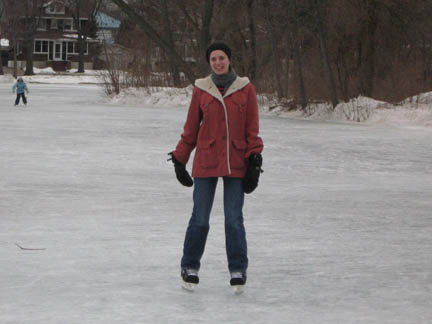 (me, before the most recent blizzard completely broke my spirit)
Nothing to say. More snow. This is the hardest time of year, when the back of winter has been broken, but it just keeps dragging itself, slowly, along, smearing its mess all over the place.
I was trapped home, alone, most of the weekend by a blizzard that threw itself against my windows, howling like a wounded animal.
I realized Sunday night that I hadn't had any significant face-to-face interactions with another human being in over 36 hours. Not good, so I made more of an effort today, actually sending a text message that included the phrase "desperate for human contact."
To make up for having nothing to report, below is a piece of writing I've been working on for my creative non-fiction class, a brief visit to another time and place:
Flying east from Manila, I lose a night, and arrive the same time I left.
This morning, which was also tomorrow morning, I pulled the gate behind me and stepped into the humid darkness. On an ordinary day, I would be greeted by a chorus of squatter children, bright eyed but toothless like old women. “Hello, Hello, Isabel-po! Where are you going today? What are you doing? When are you coming home?”
Instead, hours before dawn, I find the city eerily still, its chaos muted in the brief pause after nightlife ends and before the markets open. Eyes still sticky with sleep, I marvel at the silence as I brace myself for the long taxi ride to the airport.
Traffic enforcement was abandoned years ago, and EDSA, this vast highway slashed through the heart of the city, is innocent of stoplights, crosswalks or left turn lanes. By dawn, cars, trucks, busses and jeepneys will careen through like pinballs in a chute, horns blaring, yielding to no one; but in the stillness of 4 a.m., traffic flows smoothly, and I can hear the gentle rush of rainwater sluicing beneath the wheels as we pass through Cubao, Mandaluyong, Makati and Pasay.
The airport is harsh, bright and noisy. I submit to a cursory body search and take my place in line, cross-eyed, bent double, bags on my back and around my neck, dragging a cardboard box tied with string. I arrived three months ago with perfectly respectable luggage, and wound up dragging home a used water-filter box full of coffee mugs, unspeakably hideous t-shirts, a handmade cell phone cradle cleverly shaped as a rocking chair -- useless tokens of affection I was powerless to refuse or dispose of.
Approaching the gate, the guards check my bag one last time. No water, toothpaste or fingernail scissors – just tape recordings, reams of paper wrapped for me with infinite care, and photographs of thin faces, tattooed with suffering and unbearably young, looking straight into the camera from behind bars.
This country tears my heart out. The great, green, cloud-wrapped mountains of the north and the shantytowns of Manila, mazes of shacks over brackish water. People, children, staggering under the weight of hope or despair. The rain and the sea and the small boats on open water, held together with zip-ties and bright blue paint.
“I’ll see what I can do,” I said again and again. An easy thing to say when I have a government grant and a return ticket to a country where drinking tap water doesn’t feel like Russian roulette and I will probably never have to worry about being swept out to sea through an open manhole. I can’t help feeling like I’m abandoning a sinking ship, waving politely as I unfurl my own private lifeboat.
My last impression of the Philippines is the same as my first – the damp, vegetal air seeping into the gangway, so thick I can feel it on my teeth and my hair.
On the airplane, it’s already a new world, cool and quiet and clean. We cross the international dateline, chasing the pink of dusk, long cloud shadows on the sea as we head into darkness, hurtling towards yesterday morning.
Monday, January 29, 2007
Makes the heart grow fonder
I'm really trying to avoid starting every post with an excuse about why I don't post more often, but don't seem to be making a very good job of it. I always sort of assume that nobody actually reads this anyways, until I get a surprise complaint about how I haven't written anything in weeks. It's strange, like when people tell me they've heard me on the radio (an even more public activity that I usually treat like a private exercise).
In any case, I'm fully back in school mode, to the point where it's hard to imagine ever being out of it. I have a pretty light schedule in terms of actually having to show up for class (Tuesdays & Thursdays, plus one discussion section Wednesday), but that's balanced by taking two seminars that each require 300+ pages of reading a week. By the end of the semester, my eyes will either be buff, finely honed machines or weeping holes.
It's not even February yet, and I'm already sick to death of snow. It's hard not to view it as just a hassle, making the roads slippery, getting in my eyes. On the way home today, though, I slowed down and took the time to watch how softly the flakes settle down out of the sky, to recapture a little bit of the wonder snow awoke as a kid, in a place where it was rare enough that housewives got into scuffles over milk at the threat of a few inches.
I have such mixed feelings about the Midwest. Most of the time I feel smothered here, uncomfortable, like my edges are too sharp to be able to fit in. It was immensely reassuring to visit the East Coast and feel at home again, like maybe my problems are geographical rather than temperamental.
At the same time, though, I've gotten incredibly attached to the physical feel of this region, especially in winter. The flat, wide expanses and great gnarled oaks. Frozen lakes, dun fields, lurid pink sunsets and the moiré of snow blowing on pavement.
I miss mountains, sometimes, and the ocean so badly it hurts, but I have come to love the simple, generous, open space in this part of the world.
It's easy, though, to feel affection for a place I know I'll be leaving in just a few months. The expectation of absence, evidently, makes the heart grow fonder.
Which should not, in any way, be construed to mean that I'm not absolutely dying to get the hell out of this place.
Friday, January 05, 2007
This page was getting a bit text heavy, so here's a recent self-portrait of me not working on grad school applications...
 I actually wrote a very long post last week, only to have it disappear when my computer crashed (a problem which has become increasingly frequent and disturbing).
In any case, there’s not a great deal new in my life. Being on “break” basically means doing the same things I do during the semester, but at a lower intensity. I still have to work on grad school applications and my thesis, but in between I get to do a bit more sleeping, eating, socializing, and reading (just finished “The Spirit Catches You and You Fall Down,” about an epileptic Hmong girl and her family’s misadventures with Western Medicine – highly recommended) and watching movies (the lowest descent being “Legally Blond 2” the bizarre animal rights film of the decade and highly NOT recommended, though probably less brain damaging then a night of heavy drinking).
I’ve also recently gotten the news that all 9 of the prisoners I visited in the Philippines have been released without charges. I was very worried about their physical and mental health in prison, so it’s fantastic news, though slightly marred by the fact that they lost 10 months for a crime it was stunningly obvious they had nothing to do with, and will never receive any restitution for the jail time or the physical and psychological torture they received at the hands of the police and military.
On a totally selfish note, it means that a rather large commitment I made to translate interviews from Tagalog no longer needs to be fulfilled -- or at least not with any urgency -- so I have more time for loafing over my break.
I’m also preparing for a much needed escape from the Midwest, a trip to New York and DC that begins next week. I’m sure that Madison will be a fantastic place to come back and visit, but living here is driving me nuts and I’m champing at the bit to get away for good.
Incidentally, for those that read my previous post, I finally got a new bag. It’s less chic than the old one, but I can carry my belongings with confidence, and I’m sure that in time I’ll become irrationally attached to this one as well.
 I actually wrote a very long post last week, only to have it disappear when my computer crashed (a problem which has become increasingly frequent and disturbing).
In any case, there’s not a great deal new in my life. Being on “break” basically means doing the same things I do during the semester, but at a lower intensity. I still have to work on grad school applications and my thesis, but in between I get to do a bit more sleeping, eating, socializing, and reading (just finished “The Spirit Catches You and You Fall Down,” about an epileptic Hmong girl and her family’s misadventures with Western Medicine – highly recommended) and watching movies (the lowest descent being “Legally Blond 2” the bizarre animal rights film of the decade and highly NOT recommended, though probably less brain damaging then a night of heavy drinking).
I’ve also recently gotten the news that all 9 of the prisoners I visited in the Philippines have been released without charges. I was very worried about their physical and mental health in prison, so it’s fantastic news, though slightly marred by the fact that they lost 10 months for a crime it was stunningly obvious they had nothing to do with, and will never receive any restitution for the jail time or the physical and psychological torture they received at the hands of the police and military.
On a totally selfish note, it means that a rather large commitment I made to translate interviews from Tagalog no longer needs to be fulfilled -- or at least not with any urgency -- so I have more time for loafing over my break.
I’m also preparing for a much needed escape from the Midwest, a trip to New York and DC that begins next week. I’m sure that Madison will be a fantastic place to come back and visit, but living here is driving me nuts and I’m champing at the bit to get away for good.
Incidentally, for those that read my previous post, I finally got a new bag. It’s less chic than the old one, but I can carry my belongings with confidence, and I’m sure that in time I’ll become irrationally attached to this one as well.
Thursday, December 07, 2006
Saturday, December 02, 2006
Aquino slasher movies, and other effects of higher education
I had the most bizarre and disturbing dream last night – Corazon Aquino (post-People Power Philippine President) was forced to fight off a group of ninja assassins, cutting them up with a kris and eventually triumphing, in full slasher-movie style.
I think this probably means I’m working too hard. School anxiety dreams are nothing new, but when my research subjects start popping up in my nightmares, I think it’s gone to a whole new level.
I don’t feel like I’ve got much of a choice about it at the moment. I got through the GRE’s and the first round of grad school applications this week. I feel like I should be able to relax, rest on my laurels a bit.
Instead, I have to finish a draft of my entire thesis (about 20 pages to go), write 2 big articles for journalism, a 13 page ethics paper, and another SEAsian studies research paper, all in the next two and a half weeks.
I’ve got this bag I really like. It’s a fancy, vinyl pseudo-messenger bag. Big enough to fit my computer and books, and distributes weight well, so it rides on the small of my back when I’m biking. But its been falling apart for the past few months; the strap is ripping through from carrying to much weight for too long, and because of the material, there’s not really anything I can do to fix it. Thing is though, it still does exactly what I need it to do, so I keep on using it (though I’ll admit that I avoid carrying my computer in it). It works as well as it ever did -- better than any other bags I have -- but there’s no ignoring that one of these days it’s going to break. It’s completely inevitable. The accident will stop waiting to happen, and it’ll go, spilling its contents into the street.
In any case, the point of this is that I was walking down the street yesterday, bowed under a load of books, and I got to thinking about what a good metaphor for my brain this bag is. I’m still completely functional, but there’s no question that I’ve been pushing myself way too hard for way too long, and you don’t have to look to hard to find the places where the strain is starting to show. It’s only a matter of time.
I’m just hoping (like I’m hoping with my bag) that it’ll get me through the next couple of weeks, at which point it can snap at will, and I’ll have enough time to put the pieces back toghether before I start over.
Not terribly profound, mostly just kind of pathetic. But true.
Monday, November 13, 2006
Restorative Justice
I don't have time to write, largely because I'm so busy writing all the time. So, I thought I'd resolve the dilemma by posting some of the writing I've been doing. This isn't the greatest piece of writing I've ever done, but for something written on a tight deadline, I'm pretty pleased with it, and it's kind of a nice change to explore solutions instead of problems.
p.s. - any suggestions for headlines?
The .22 caliber bullet that pierced her skull took a lot of things away from Jackie Millar. Shot in the back of the head and left for dead by teenaged car thieves in November 1995, Millar will never recover full use of her body. She’ll never be able to go back to the job she loved, or take any more of the photographs of forests and mountains that decorate her apartment. She can’t walk in high-heeled shoes, or see clearly as her sons Chad and Derek mark their passage to adulthood.
“I should be dead,” she said. “I am legally blind. I am paralyzed on the right side of me. I. talk. slow. My long- and short-term memory is hit-and-miss. All because they wanted my car.”
But Jackie didn’t lose her ability to forgive, and to love. She keeps framed photographs of Craig and Josh -- the teenagers who laid her on the floor and calmly discussed which of them was going to shoot her -- to show to visitors. “I love Craig and Josh,” she said.
“They tried to eliminate me,” she said, and she’ll never forget it. But, “I wanted to get my life back, and I knew that forgiveness was something I’d have to do.”
Working with mediator Bruce Kittle, the former director of the Restorative Justice Project at the UW-Madison Law School, Millar began to communicate with the boys who shot her. “I love restorative justice. It played an important part in the healing process for me,” said Millar. “It is a chance for the perpetrators and the victim to meet side by side, for the perpetrators to ask for forgiveness and for the victim to get to forgive them.”
Millar has visited both of the boys who shot her, and writes them regularly. This process has been instrumental in giving her closure and in forcing her shooters to take responsibility for the damage they’ve done to her and her loved ones. “Craig and Josh won’t forget me. Craig said it best. He said it doesn’t matter if he’s in prison or not, it will plague him until the day he dies.”
The practice of victim-offender dialogues draws on Maori and Native American traditions that focus on bringing victims, perpetrators and their communities together to find ways to repair the harm caused by crime, instead of emphasizing punishment or revenge. According to the web site of the Center for Justice and Reconciliation at the Prison Fellowship Institute, the concept spread from these traditional practices to social service and police agencies. At present, the group’s Web site estimates about 300 programs in the United States operate on these principles.
UW-Madison’s program, the Restorative Justice Project, started in the late 1980’s, when law students and professors searched files at minimum-security prisons for cases where victims and offenders might want to meet, said program director Peter DeWind in a telephone interview. Today, DeWind said, the project works on about 10 cases a year, accepting only victim-initiated requests – partly because they already receive more from requests from victims than they can handle, and partly because he fears pursuing offender-initiated cases risks re-victimizing crime survivors.
The program now works primarily on cases involving severe violence, including homicide. “These cases are often the most valuable, because there’s such emotional trauma and damage to people that there’s often no other way to really relieve,” said DeWind. Giving crime victims a chance to express their emotions --whether anger or forgiveness -- “often eases a lot of those negative emotional effects”
Because most of the offenders remain in prison, it is difficult to gauge the program’s success by traditional markers like recidivism, said DeWind. But, he said, “I just treat it as successful if people are glad that they met.” Follow-up interviews, he said show “virtually without exception, that’s been the case.”
Shelley Justiliano, a victim services program specialist for the Wisconsin Department of Corrections said the DOC fully supports the work of the Restorative Justice Project, adding that victim-offender dialogues are “just one tiny aspect” of the restorative justice model the department embraces.
“Lots of things are restorative that we’ve doing forever, like paying restitution,” Justiliano said in a telephone interview. The Department of Corrections also offers victim impact classes, where prisoners spend as many as 16 weeks examining the effect of crime on society – looking at everything from insurance fraud to homicide and sexual assault. Prisoners listen to victims who come in to speak about their experiences, and go through exercises like calculating the cost of their stay in prison or writing their own obituaries as though they were homicide victims. In some prisons, she said, inmates have donated crafts to be sold to benefit victim services programs. The state also tries to give victims the options for input, allowing them to write victim-impact statements for the trial or to appear at parole hearings.
“It’s not a class or a specific program, it’s a way of looking at crime,” Justiliano said. “The model is a triangle, an equal sided triangle. The three sides are occupied by the offender, the victim and the community, and the restorative justice model alludes to the fact that they’re all affected equally.”
Restorative justice is “a lot more meaningful than just fining people or putting people in jail,” said Merry Kay Shernock, a probation officer from Northfield, Vermont who has collaborated with programs in her district since 1997. In a telephone interview, Shernock emphasized the practical value of restorative programs. “Punishment is expensive. If you want to incarcerate people to punish them you have to feed them, you have to give them a place to live. Restorative justice actually makes money, creates value, especially when the offender gives community service.”
The townships Shernock works in offer a number of restorative programs aimed at facilitating offenders’ re-entry into society and finding ways for them to make amends for the harm that they’ve done. The most common, she said, are reparative boards -- citizen volunteers who meet with offenders to draw up contracts for how the offenders can repay the damages they’ve caused to their communities.
“It’s a really ancient idea -- You make a mess, you fix it, you clean it up,” said Shernock. “If you got drunk and drove over Mrs. Johnson’s petunias, the right thing to do is go over and replant them.”
The contracts, which are decided by consensus between the board and the offender, seek to include the needs of as much of the community as possible. In one case, Shernock recalled, “A man got terribly drunk and plowed into a pedestrian bridge and destroyed it.” Before the accident, elderly people stood on the bridge to throw crumbs to ducks, and one consequence of the accident was that the ducks went hungry. As a result, said Shernock, “Part of his contract was that he had to feed the ducks until the bridge was rebuilt.” After all, she said, “One of the biggest impacts of his offense was on those poor ducks.”
In the end, added Shernock, the ducks got fed, and the offender later told her that having to get up in the cold every morning “really made him think about things.”
And that, she said, is the best she can hope for. “We don’t ask, ‘Does this reduce the crime rate?’ The question we ask is ‘Was the victim compensated, were amends made to the victim?’ That’s what we care about -- that wrongs were righted, to the extent possible.”
The restorative justice model can also help societies recover from human rights abuses or mediate international conflict, said Kyle Leighton of the Restorative Justice Initiative at Marquette University. Bodies like the Truth and Reconciliation Commission in South Africa, where offenders publicly took responsibility for crimes committed under the apartheid system and victims were given an opportunity to tell their stories, move beyond a dialogue between offenders and the state, he said. “I think it can be really healing for a society, for all aspects of a community, to take part in that conversation.”
In honor of restorative justice week, which begins Nov. 12, Marquette University will host a sold-out international conference on the 13th, titled “Healing after Political Violence,” bringing together people from around the world to share their experiences with restorative processes. Separate events, with the theme of ‘creative partnerships, collaborative action,” will be held throughout the week at prisons across the state.
Tuesday, October 31, 2006
Just one damn thing after another
Finally catching up on email after being away for the weekend and finishing up a chapter of my paper, I found myself reading through news briefs ... Indymedia reporter shot dead in Oaxaca ... thinking "shit, that's awful" and then "wait, Brad Will...is that..." yeah. it was. Brad from New York, the lunatic who stayed inside his Lower East Side squat and tried to face down a wrecking ball. Brad who I used to sleep next to in Seattle. Just one more person I let slip away over the years. I never even knew his real name till I read about him lying on the sidewalk with a bullet in his chest.
I wish I could say that it just inspires me, makes me more determined to keep walking the path I'm on, keep telling the truth about the bastards, but it doesn't. It just makes feel sad, and tired, and old. Wishing that, just once, I could get through this time of year without having to deal with the horrible death of someone I care about.
I've been thinking though, about this conversation we had the first time I met Brad, in Minneapolis in 1999, talking about planting flowers at squats, sowing seeds you'll never see bloom, just because it's a good thing to do, putting a little more beauty in this world.
So I'm just going to try and think about that for a while.
More about Brad: http://www.narconews.com/Issue43/article2223.html
http://nyc.indymedia.org/en/bradleywill/archive.html
Thursday, October 26, 2006
The Ivory Tower
Note: I wrote this a couple of days ago, but coulnd't get it to post until now. See, even why I try to do this more often, I fail.
The combination of dealing with grad school applications and attending a Southeast Asian Studies conference this weekend has me thinking a lot about academia in general. Specifically, the way in which some people seem to educate themselves into irrelevance.
I mean, I'd like to think I'm pretty well read, and I've basically completed the requirements for a degree in Southeast Asian studies, but there were a couple of papers presented that left me scratching my head, wondering a) what the hell they were on about and b) why I, or anyone else, should give a shit. Papers where people descended so deep into theory that any connection to reality seemed at best tangential, that seem like they could only possibly be of interest to other academics.
(I'm not condemning the conference as a whole, there were a few really good panels, where people seemed to be making a sincere effort to use their knowledge about a subject to contextualize current or past events -- particularly coups in Thailand -- in a meaningful way, and seemed to want to contribute to a larger public dialogue.)
I've generally been questioning the purpose of higher education, especially since deciding to stay in academia for at least a couple more years.
I'd like to think of it as a way to better prepare myself to be of some use to society -- partly because, as a student at a public university and the recipient of thousands of dollars of grant money, my education is heavily subsidized by society, which seems to me to create an obligation to give something back. More broadly though, I guess I can't imagine feeling satisfied with myself or my work if I wasn't doing something at least slightly useful to other people. Granted, probably nothing I ever do will have as much tangible value as a paramedic or a garbage collector, but that doesn't mean it's not worth trying.
On the other hand, there's a part of me that feels like anything that people do with their lives that's done out of genuine passion makes a positive contribution to society as a whole, if only because it means there are fewer bitter people roaming the streets. I mean, practicalities aside, I'd rather live in a world full of people who feel intellectually fulfilled by publishing arcane articles in obscure journals than in a world full of people who hate whatever it is they spend the majority of their conscious life doing. At the same time though, considering how few people really have the opportunity to spend decades in school, to do nothing more with it than sit in a small room and talk to people who are just like you seems like, to put it mildly, a bit of a waste...
Saturday, September 23, 2006
I’ve been quite slack about posting lately, mostly because I’m not really sure what to say. I’ve just been busy with school, work and the radio station. It’s all interesting to me, but not the kind of interesting that makes me feel compelled to write about it.
The satisfactions are small, but not to be discounted – encountering a new idea in an article, finding a perfect quotation to support a theory, moments of competence at work. I’m still working out how best to balance work, school and loafing.
Fortunately, I have no social life to worry about, at least not here in Madison. It’s funny....I do vaguely recall having had social skills at some point in my life, and still have the old friends to prove it, but I seem to have checked them at the Wisconsin border. Some of it’s just being busy, and consequently lazy about socializing. Even when I have the chance to go out with people, I usually would rather just go home, be by myself and rest. And then, I wonder why I haven’t made any close friends here...
There is definitely something about Madison though...I’ve been here nearly two years now, but have fewer friends than I did after a month in Manila (where I was equally busy), or really pretty much anywhere else I’ve ever spent more than a week. I suppose it’s because I didn’t come to Madison because of any interest in the people here.
In any case, my (non-superficial) contacts with other humans have been boiled down to communication with people who I already have close enough relationships with to communicate with long distance or travel hours to visit, and who tolerate me no matter how strange, intense, spastic or withdrawn I become. So, I’m afraid, I’ll only get worse until I finish school, and, with luck, go somewhere very, very far from here.
In the meantime, look for me at the library. But don’t expect to find me, especially now that I’m working there and have keys to even more isolated and far away rooms than ever.
Sunday, September 10, 2006
Summer is over. It will almost certainly get warm again, but the back of summer has been broken. Two days in a row now I've found myself regretting not putting on gloves before leaving the house.
It's odd to have moved so quickly from the stifling stickiness of the tropics into flannel sheet and hot drinks season. ... I was going to say at least the rain is the same, before realizing how patently false that is. This cold, endless drizzle is absolutely unlike the temperamental bursts of monsoon fury.
In many ways, it's wonderful to be back here, to a place where drinking out of the tap doesn't feel like Russian roulette, where I can walk down the street without feeling like a space alien or worrying about falling in open sewers or having my heart broken (or, for that matter, my pockets picked) by street-children. At the same time, especially in the Midwestern blandness of Madison, I find myself missing the energy, the almost indescribable chaos of Manila.
Being home though -- there's no bitter in that sweet. Not "home" in the sense of back in Madison, but home in the sense of not being a guest in somebody's house. Indulging in the innocent pleasures of putting things where they belong and wearing clothes out of a closet instead of a suitcase, and the slightly guilty pleasures of staying in bed reading until noon and making a mess if I damn well please. I'm settling back into my old routines, and trying to develop some new ones as well. My schedule is almost entirely self-directed this semester. I have only two classes that actually meet, and the rest in all independent work. I've actually been at bit bogged down the past week, the inevitable consequence of changing my thesis topic in the middle of the summer. I'm scrambling to get back to where I was at the beginning of the summer. On which note, I should probably actually be working
Wednesday, August 30, 2006
Loose Ends: Mindoro Photos
So, now that I'm back stateside, with regular access to technology, I'm going to start posting some of the photos and notes I've been accumulating over the last weeks. To begin, here are some photos from Mindoro, where I spent the 4 days of actual vacation that I took this summer, waking up and swimming, eating, going for a walk, swimming, going for another walk, swimming, eating, maybe swimming again, and then going to bed early... I really know how to whoop it up. Actually, I did meet some nice people, stayed out past ten a night or two, did a bit of irresponsible late-night motorbike riding on unlit, unsealed roads, got a bad chest cold, and other fun vacation activities. But mostly, I remember swimming.
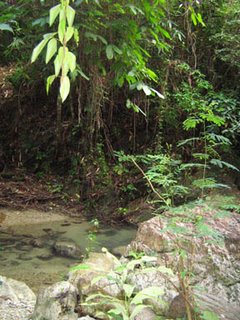 Talipanan, where I stayed, butts right up against the nearly impassable spine of mountains separating Mindoro Oriental and Occidental. The picture above was taken on a hike up through a series of waterfall pools running down the mountains. I didn't make it all the way to the top, because I was on my own, it was evening, and I was afraid of getting trapped in the dark and eaten alive by malarial mosquitoes. Still, it was a nice walk.
 Manyan kids, members of an indigenous community that is being increasingly marginalized and dislocated by the aggressive development of the tourist industry in Puerto Galera. A tourist industry that I was, peripherally, taking part in. Errch. In any case, these kids were really excited about having their picture taken (which is more obvious from the kids in the back than the ones in the front). One of the nice aspects of feeling like a tall, white space alien was that it made the tourist dynamic a little more two sided -- people were always at least as interested in looking at me as I was in looking at them.
 Ahh, the beach. What can I say?

A river, just before emptying into the sea.
 Talipanan, where I stayed, butts right up against the nearly impassable spine of mountains separating Mindoro Oriental and Occidental. The picture above was taken on a hike up through a series of waterfall pools running down the mountains. I didn't make it all the way to the top, because I was on my own, it was evening, and I was afraid of getting trapped in the dark and eaten alive by malarial mosquitoes. Still, it was a nice walk.
 Manyan kids, members of an indigenous community that is being increasingly marginalized and dislocated by the aggressive development of the tourist industry in Puerto Galera. A tourist industry that I was, peripherally, taking part in. Errch. In any case, these kids were really excited about having their picture taken (which is more obvious from the kids in the back than the ones in the front). One of the nice aspects of feeling like a tall, white space alien was that it made the tourist dynamic a little more two sided -- people were always at least as interested in looking at me as I was in looking at them.
 Ahh, the beach. What can I say?

A river, just before emptying into the sea.
Tuesday, August 15, 2006
Back in Manila once again, this time after a trip up north to the cordilleras. It was definitely the most beautiful part of the Philippines I've seen so far, but that experience was totally overshadowed by interviewing political prisoners in benguet province. I've been working on transcribing and translating horror stories of torture and injustice, so I wasn't in much of a vacation mode. I'll maybe post some later for those who are so inclined, but for now I'm just trying to get myself sorted out again here.
Wednesday, August 09, 2006
Hopefully, this will work now. As with many things here, internet access is a bit inconsistent, although this connection seems quite good.
I'm back in Manila now, or Quezon City to be precise. I find myself surprisingly happy to be here again. Even though people stare at me like I have a third eye, at least they stare at me like a human with a third eye instead of a walking dollar sign. As noisy and chaotic as Manila is, at least I can walk down the street in (relative) peace.
It's funny, people always assume that I don't understand what they're saying in my presence. It's usually nothing very interesting though -- 99% of the time it's a comment about my height. Which is very, very noticable. I went to the market earlier this afternoon, and had to hunch over almost the whole time to keep from hitting my head on various trade goods suspended from the ceiling. Much amusement for everyone.
And then, when people discover that I do understand, the first thing they ask is often whether I'm a mormon. Go figure.
Tomorrow, I leave to head up north, to the Cordillera region. It's an area that's very remote and beautiful, and also very popular with tourists, so I'm sure I'll encounter many of the same irritations there as in Mindoro. I suppose getting treated like a tourist is a just punishment for being a tourist. I'm not even sure how useful Tagalog will be up there. Ilocano is much more widely spoken up north, along with local and tribal languages. I'll have a companion this time at least, a friend of one of my classmates, who also wants to visit the cordilleras. For better or for worse though, he's another very tall white person. I didn't feel unsafe travelling alone, but people definitely found it very, very strange.
Sunday, August 06, 2006
So, I decided it was time to leave Manila for a few days. It's almost indescribably dirty, hot, loud and crowded there and it was definitely starting to get to me. For just a few dollars, it's possible to get a boat to a clean, quiet place with a beach, which is what I decided to do. I decided it was time for a few days of hedonism before returning to reality. After this, I'll be going to UP to do reaseach, and then return to the states where I'll have a few days to move back in to my apartment before school starts, so this is pretty much my only chance for a vacation.
I'm in Mindoro now, near Puerto Galera. The village I'm staying in, Talipanan, is quite nice -- very quiet (except for the shouting Korean family staying next-door), small and friendly with a few family-run guesthouses. ( I'll try to upload a few pictures in a minute, but I want to post this before I try anything that fancy on this computer.)
The problem is that most of the rest of this part of the island is a tourist resort, which means that it's pretty hard for me to walk down the street without about 6 people trying to sell me something I don't want at exhorbitantly inflated prices. I try to remain sympathetic to people who are just trying to make a living, but it can get pretty aggressive. For example, I wanted to take the jeepney (regular public transit) into town this morning, but while I was waiting, I was surrounded by a veritable plague of tricycle drivers trying to charge me 5 times the normal fare to ride with them instead, in spite of my repeatedly insisting that I just wanted to take the jeepney. It's an aspect of the Philippines I haven't really had to deal with yet, because so far I've always been with Filipino companions or in urban areas where people pretty much leave me alone.
In the end, it usually turns out okay, but only because people are so amused by my Tagalog that I can usually redirect the dialogue into a conversation about their wives and kids, or various relatives who are overseas workers in America.
The other thing I have to concede is that even when people do overcharge me, at least they're nice about it. They'll charge 5 times the local fare, but they'll make sure I get exactly where I need to go, and that I'm safe and well taken care of when I arrive.
To be honest, I don't even particularly mind paying a bit more than the locals for services -- I mean, when you start thinking in terms of percentage of hourly wage, it's ridiculous to quibble about a quarter which really means nothing to me, but can make the difference between some vendor's kid going hungry or not. It does seem like there's a certain amount of justice in people who have more money paying more. Still, there's a point between where economic justice turns into just plain getting ripped off, and you do have to draw the line somewhere.
On that note, this internet connection is pretty steep as well, so I'm going to wrap this up and save the more serious thoughts until I get back to Manila.
Subscribe to:
Posts (Atom)
